Tuesday, October 23, 2012

Medium Specificity - Glitch Art


Artist's Statement


I have seen all of these paintings on the internet. As Magritte so wonderfully depicted, these paintings, all full of disturbing or scintillating life, are no more than paint upon canvases. My whole interaction with them and my entire knowledge of them stem from the internet, the paint depicted on LCD screens - another frame away from reality. They are no longer paint upon canvases, but pixels on a screen - and even deeper, binary code. The physical painting loses its texture, its brush strokes becoming gauche flatness made of red, green and blue. The pixels are zeroes and ones, the raw data a mess of indecipherable static.

Van Gogh's Starry Night in .raw format

When you reduce a masterwork of art into binary, is it still valuable? The physical strokes traced by the artist's own hand are gone, no longer a testament to the careful recording of the transcendental inspiration or moment of sublimity. With that gone, it is only an image on a screen - even less, a castrated set of pixels, void of the deeply spiritual and humanistic ties with the creator, that relationship rendered mute. I decided that I might as well take it a step further, and visually portray the images as their stunted counterparts to the physical, hand-crafted canvas. Their faults are made bare, static and inverted colours overpowering the original paints. The medium is the digital image, the specificity is code.

Hit the jump for the originals and a brief statement.

Tuesday, October 16, 2012

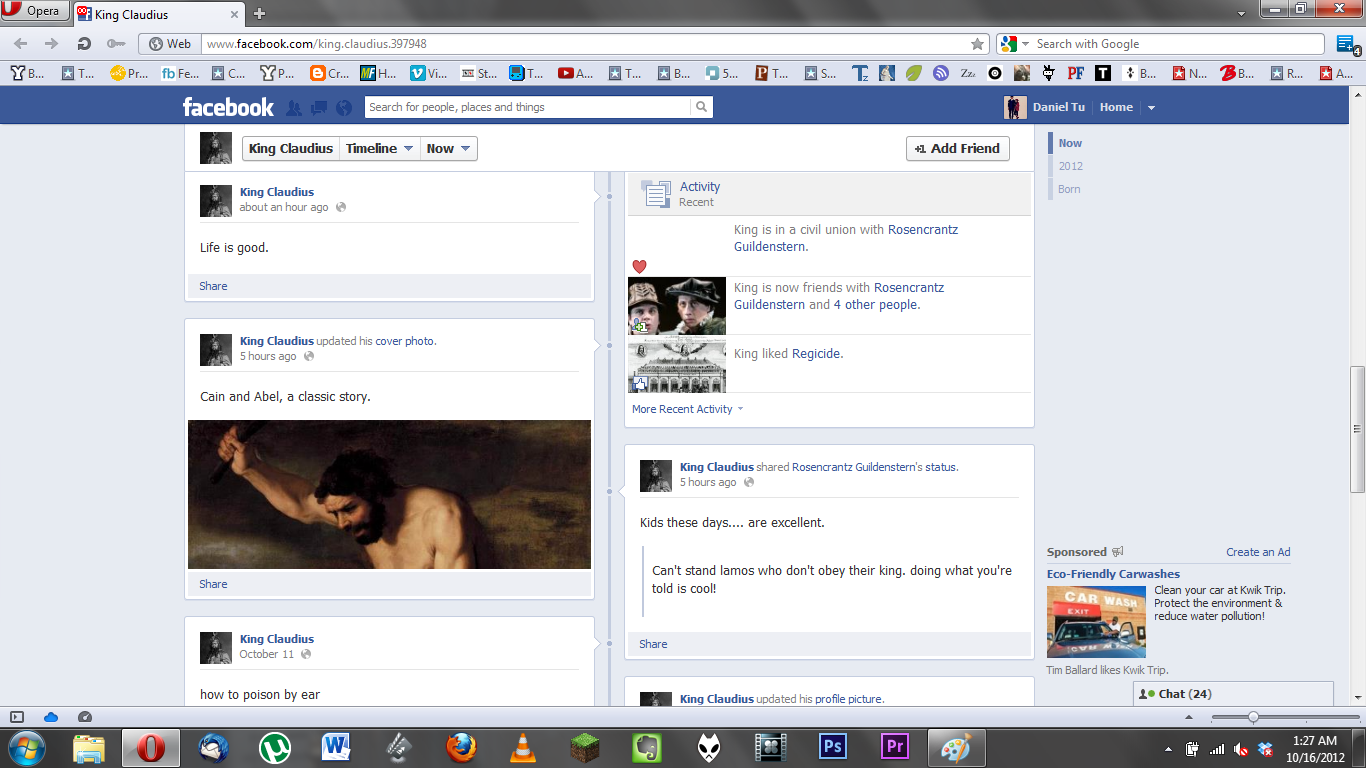
Social Media Adaptation - Hamlet


(Click to enlarge)

Hamlet's Profile (Link to Facebook)


Artist's Statement:

For our assignment we decided to adapt William Shakespeare's "Hamlet" using Facebook. We felt Facebook would be the best way because we wanted to focus on the characters and their interaction and Facebook profiles let us do this. Rather then a chronological series of events we decided to use more of a conversational approach, and show the interactions between characters.

 We decided rather than photoshopping a Facebook list of things that happen in the play we would create fake Facebook accounts and interact. This way of thinking forced us somewhat to think how the character was thinking and formulate what he would say different contexts.

One problem that significantly effected what we were trying to do was the fact that some of our profiles were being deleted as well as their posts and comments.

Tuesday, October 9, 2012

Good Music That Everyone Should Hear: Das Racist

If you hate rap, then you haven't been exposed to enough rap. That's where these guys come in - Das Racist are a pair of rappers from NYC and Alameda, and they are obscene and vulgar brown men. However, they are also the most literate and hilarious rappers I've heard in a long time - it's hard not to open a new tab while listening and voraciously googling every reference they make, from Rumi to Gitmo to Harold and Kumar.


Joke rap sucks though, right? Well, not really, and especially not when it's as self-reflexive and intelligent as Das Racist are. They succeed in the face of the backpack-rapper backlash - people are sick of hearing about the shortcomings of hip-hop, but Das Racist bring those topics up and mock them without being didactic and preachy - quite the opposite, in fact. Just listen to the opening banter on hahahaha jk, and we already have a discussion and implicit derision for the tough-guy persona that most rappers build up.


Their discography is pretty slim at the moment - they came up with the rise of "internet music" and have only released two mixtapes and one retail album, as well as a handful of solo mixtapes and some unreleased stuff in the invaluable URC collection: a .rar full of their rarities and features, definitely worth checking out. If you're still undecided, give the impressive Womyn a listen:


They released their best stuff for free online, which you can grab when you hit the jump:

Textual Poaching - Samson and Delilah


Artist's Statement


I chose to use Klaus Nomi's Samson and Delilah aria mainly because of his persona - he donned the mantle of a complete and utter "other", and his music comes from that perspective. Having been born as an ethnic minority in a largely racist country, and growing up as a Mormon in a largely atheist country, it has been easy for me to relate to the outsider's perspective. I also decided to use visuals from Paul Thomas Anderson's Punch Drunk Love in order to complement the Nomi song as it is a film that champions the role of the introverted outsider. Both of these texts speak from a similar viewpoint, and I tried to create a comparison and suggest intertextual links between these two works that I admire deeply.

Klaus Nomi's otherworldly persona.

Nomi was a social outsider due to his sexuality, which he manifested visually in his bizarre appearance and theatrical stage performances. Despite his strangeness, he was still a classically trained singer and had an excellent ear for music, as shown in his performance of this aria - it is something of an anomaly on his pop/new wave fuelled LP, and stands out as a nod to the classical masters - the artists that went before him. I find it particularly beautiful, and decided that rather than cutting it up and producing a garish "remix," I would recontextualise the piece by placing it alongside images in a pseudo-music video format. I hoped that this would change the meaning of the piece and highlight the aspects that I can relate to. I followed the example of Joyce's Ulysses and Finnegans Wake by taking fragmentary moments and letting them run together, rather than telling a narrative. I feel like this pushes the focus towards the music.

Although I am not as extreme an outsider as Nomi, I can sympathise with his position and can appreciate his efforts as an artist. In my home country, I was a racial and religious "other." This was a central part of my identity regardless of whether I wanted it to be, and I feel as if I have grown into the role. On the other hand, I am also an aspiring artist and I believe in the unifying nature of art - even the most homophobic individual would have a hard time deriding Nomi's beautiful rendition of Samson and Delilah. This is proof to me that the acknowledgment of beauty is a natural, almost primal quality, and that it can overcome the discriminatory viewpoint that some individuals are taught and eventually embrace. This is not to put myself into the role of a token performer, but to give myself hope and an ideal to aspire to in my work.

The people I shared this idea with liked it but didn't offer any deeper feedback - they could draw textual links but I needed to explain the way they related to me, as it related to often unspoken aspects of my childhood and youth, and the overt and covert discrimination I faced.

Friday, October 5, 2012

Belated Review: Nas - Life Is Good


This is Nas' best album since I Am. That beat. Those raps. Holy crap.

This first track sounds like a John Woo movie. Holy crap. This is too much. Just listen to these words.

PS 111 had free lunch
Embarrassed but managed to get a plate


We was kids hungry
Mom's working, I was famished
She getting home late


How could I not succumb
How could I not partake
Fifteen I got a gun
Sixteen I robbed a train
Licked off a shot for fun
What's got inside my brain
A hustler's job ain't done, til he becomes a king


Thursday, October 4, 2012

Good Music That Everyone Should Hear: Ghost Mice

If you've never heard of folk-punk, Ghost Mice are an excellent gateway drug. They're ineffably sincere, full of heart, they sing with conviction and yet they write songs about dumpster diving and Dungeons and Dragons. Make no mistake - they aren't limp-wristed geek panderers, they're all out punks. Acoustic only, yes, but the DIY ethos shines strong.


Chris Clavin, the guy who leads the band, is over 30 years old but still manages that adolescent, nasally wail that I have come to cherish as a throwback to my friend's teenage bands - full of hope and piss and vinegar. He sings about things of importance - anarchy and institutionalised brutality, childhood and child-molesting priests, all of it with the same earnest, untrained voice.


One other thing that you should know: Chris Clavin heads the stalwart Plan-It-X Records, a beacon to folk-punk and independent music (not that crap you heard on NPR or Pitchfork, but actual shipping-out-LPs-covered-in-crumbs-from-their-basement independent.) Their roster is extensive and has some excellent releases, almost all of it worth listening to.

If you're interested, get a hold of their splits - releases in which they perform on one half of the album and another band does likewise. I could recommend their split with Andrew Jackson Jihad, another excellent folk-punk band, and their split with Saw Wheel - admittedly not a huge fan of Saw Wheel, but the Ghost Mice side redeems it. Also, required listening: their album The Debt of the Dead. It's one of their fuller sounding albums, and has some excellent songs.

If you like them so far, you can buy their super cheap releases here. If you don't like them, then listen to Cementville from start to finish and then change your mind because you are wrong:

Monday, October 1, 2012

Historical Story - Innovation

Link to screenplay


Artist's Statement


Writing a script surrounding a historical event can be a tricky process. What we take for granted today - commonplace gadgets, vocal nuances, and such - could be completely out of place or even nonexistent in the world of a couple decades ago. However historically incorrect that may be, in some instances old and new have been interwoven successfully, like Baz Luhrman's Romeo + Juliet (1996).

For our screenplay surrounding the history and possible controversy over the invention of the ballpoint pen, we were happy to keep the setting in the postwar 1940's. The time period isn't only correct for the emergence of the ballpoint pen, but it provides an interesting era of Caponesque mobsters and hitmen. Since the 1940's is saturated with the hatred and despair of war, it can be argued that the method of killing for sometimes little to no purpose had become more brutal. Think of Bonnie and Clyde's notorious run as criminals and killers, and multiply that by at least 10, because their number was up in the mid-30's, and by then they had done a lot of damage. 

The reason we felt justified in collaborating on a violent script surrounding the invention of the ballpoint pen was because we wanted to show how senseless conflict can be and how ridiculous our reasons can be for starting a conflict that will result in the loss of innocent lives. Just like Laszlo - our inventor - says, "But it is just a pen, it is no master weapon!"

The graphic novel, After the Deluge, addresses a question similar to this when the refugees of the flooded "bowl" were treated with neglect and even hostility from military groups who should have been passing out water and food instead of training their gun barrels at them - the cycle repeats itself.

Over all, we hope that our script doesn't gratify and entertain more than it makes a valuable point, because this is an important topic to address: What justifies violence? And who really has the right to decide when or if it's okay to disregard and even threaten innocent people's lives? 

By Daniel Tu and Gina Thompson