Saturday, May 4, 2013

Barry Lyndon and the Oil Painting Filter Effect in Photoshop CS6

I watched Barry Lyndon today and was quite taken aback by the way Stanley Kubrick mimicked the style of the paintings of the era. I was told that you were supposed to use light to create a sense of depth, but Barry Lyndon eschews this and does the obverse, flattening the image to create the sense of a two-dimensional canvas. I tried to highlight this by vulgarly applying the "oil painting" filter in Photoshop. Don't they look just like paintings?


Wednesday, December 12, 2012

Fireside Chat

Artist's Statement


Mark Romanek once said, in reference to an interview given by Kubrick, that the best way to describe good art was that it had to be "more daring and more sincere." I feel like our class was able to fulfill both of these criteria on this night, and the spirit was not just one of empathy and pity, but one of appreciation. I feel like there are some good artists in this class.

Initially I wanted to tell a ghost story I had heard on the internet, because it was very scary and disturbing, and there's a malicious impulse in me that likes to see people squirm at what I can make or perform. However, I decided to change my story at the last minute and stayed up until the sun rose writing something on a scroll that I would then read out. I feel like this was a good change, as the end result was much more sincere, and much more daring, and hopefully still made people squirm in a conversation that speaks of the grand importance of human life and one's fellow man. The story was completely true and really did happen to me when I was ten and a half, and every detail is exactly as I remember it - I made a conscious decision to write in a journalistic and literal sense, enveloping the event with small and uninterpreted details. I feel like this compounded the effect of the story and helped make it feel less like a story. The transition to the present was accompanied by a transition in style - I wrote more in verse than I did in the stream-of-consciousness diary entry of the childhood perspective. The ending was written in the third person to relate the idea that I needed something external and greater than myself to reassure me and comfort me, this being the belief aspect of the assignment.


I got the idea for the scroll from Saul William's amazing poetry slam performance, which discusses rap and spirituality in an obliterating way. I arrived at most of the other stylistic decisions serendipitously and they turned out well. I didn't use a song or a video or any pictures but used the scroll as a prop that would reaffirm the stream-of-consciousness style in that it is literally a physical "stream" of my consciousness.

I really enjoyed this assignment and I really enjoyed the work of my peers, and I feel like it was an uplifting experience that benefited everyone that participated. I feel like I over-shared, but I'm okay with that, and I feel like it was worthwhile.

Thanks for this class.

Tuesday, December 4, 2012

Assignment Suggestions

When looking back at art and film through a scholar's lens, we often categorise the various periods and style changes as genres or movements - some of these arose fluidly and naturally, whilst others were constructed and deliberately formed. Art movements offer a unique opportunity to be a part of a creative community with a unified goal, but with different and personal manifestations of that goal.

Create a Genre:
Working in groups of 4, you will meet and discuss the creation of a new genre, micro-genre or art movement. Define your objectives, your worldview, your collective aesthetic, your choice of medium and what makes you distinct as a new art movement. Draw up a manifesto, or forgo one if your movement calls for it. You can draw from an existing culture to create a subculture or counter-culture, or you can be entirely original. Working individually, but consulting one another, each member of the group will create a piece of art in whatever medium suits your movement, which you will present to class in tandem with your group.

Example: The Seapunk micro-genre was created as a joke by a loosely assembled group of Tumblr users and the internet personality @Lil_Internet. Its aesthetic has since become co-opted by popular rappers and performers Azealia Banks and Rihanna in recent performances, and the style has been adopted by Lady Gaga and Taylor Swift, among others.


We've explored the artistic process in our class, but we have yet to analyse the specific ways that media can directly effect a viewer. Propaganda can be used for good or for ill, for corporate or political or even humanitarian aims - we will be discussing the latter in the assignment.

Propagandhi:
Students will find and research a humanitarian cause - the positives and the negatives, the counter-arguments and the benefits. They will then decide their stance on the cause, and create a piece of propaganda that will influence the viewer towards making a direct change in regards to the humanitarian issue. It could be as simple as a poster or as complex as a stickerbomb or documentary. The student will then post or display it in a public space (without breaking laws) and gauge the reaction of the viewers. Your goal is to manipulate or change your viewer in some way.


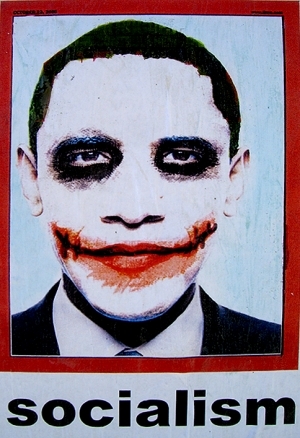
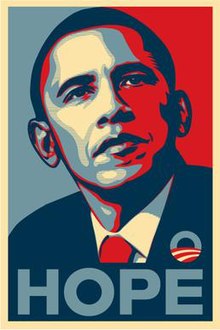
Example: Shepard Fairey's work is heavily informed by propaganda, which reached a peak with his famous Hope poster for Obama's campaign - another artist made a detracting statement using a similar method, and both artists influenced their audience effectively. How can we make images that are powerful enough to change minds?


Tuesday, November 27, 2012

Concerned Citizen - Kendall Wilcox

Artist's Statement


The hardest part of this assignment was choosing what part of the interview to use - with a time limit of 3 minutes, it would be hard to include all of the depth and richness of the conversation. As such, we decided to focus on his personal story - not only does this reinforce the idea of empathy, it places the viewer in a specific context and mood and offers something of a complete narrative, and hopefully prompts the viewer to continue the thought process themselves.

We wanted specifically to interview an individual that had a definite contrarian viewpoint, whose experiences would help diagnose the society in which they lived - Kendall is not only a minority within a minority, he is an entrenched "other" and has a clear understanding of Mormon culture in spite of this. We feel that his perspective is invaluable and can prompt necessary and edifying dialogue. Through speaking with him, we were able to enter a conversation that we would have neglected otherwise, and that provided us a chance to forgo pity and sympathy and practice empathy in a real and meaningful way.

We chose to make this largely a talking-heads documentary as the theme is dialogue, and we wanted to reinforce that. We inserted shots of his belongings and apartment in order to visually convey a sense of personality and meaning. Jake conducted the interview and operated the camera and microphone, and Daniel edited it.

Monday, November 5, 2012

Protest Poster - False Profit


Hit the jump for the Artist's Statement.

Tuesday, October 30, 2012

Webspinna - Sources


Hit the jump for the artist's statement.

Tuesday, October 23, 2012

Medium Specificity - Glitch Art


Artist's Statement


I have seen all of these paintings on the internet. As Magritte so wonderfully depicted, these paintings, all full of disturbing or scintillating life, are no more than paint upon canvases. My whole interaction with them and my entire knowledge of them stem from the internet, the paint depicted on LCD screens - another frame away from reality. They are no longer paint upon canvases, but pixels on a screen - and even deeper, binary code. The physical painting loses its texture, its brush strokes becoming gauche flatness made of red, green and blue. The pixels are zeroes and ones, the raw data a mess of indecipherable static.

Van Gogh's Starry Night in .raw format

When you reduce a masterwork of art into binary, is it still valuable? The physical strokes traced by the artist's own hand are gone, no longer a testament to the careful recording of the transcendental inspiration or moment of sublimity. With that gone, it is only an image on a screen - even less, a castrated set of pixels, void of the deeply spiritual and humanistic ties with the creator, that relationship rendered mute. I decided that I might as well take it a step further, and visually portray the images as their stunted counterparts to the physical, hand-crafted canvas. Their faults are made bare, static and inverted colours overpowering the original paints. The medium is the digital image, the specificity is code.

Hit the jump for the originals and a brief statement.

Tuesday, October 16, 2012

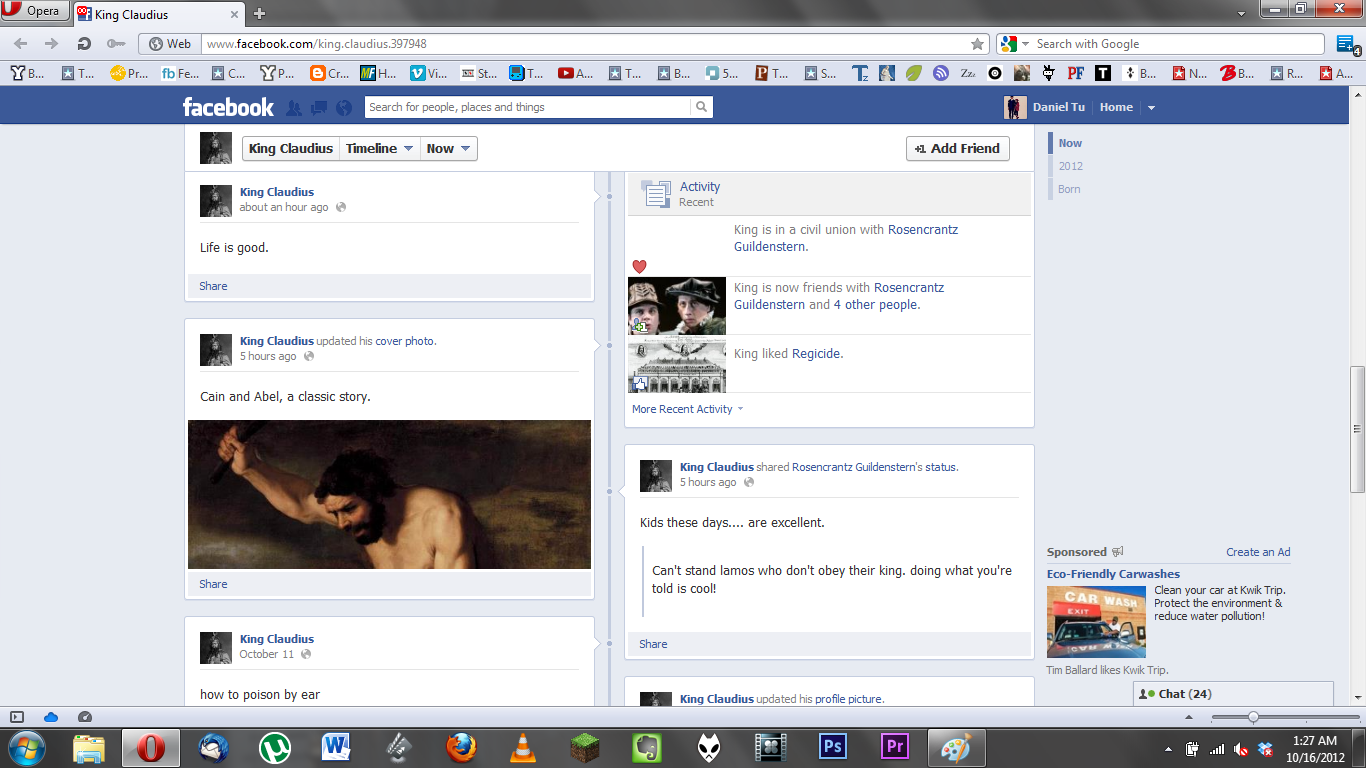
Social Media Adaptation - Hamlet


(Click to enlarge)

Hamlet's Profile (Link to Facebook)


Artist's Statement:

For our assignment we decided to adapt William Shakespeare's "Hamlet" using Facebook. We felt Facebook would be the best way because we wanted to focus on the characters and their interaction and Facebook profiles let us do this. Rather then a chronological series of events we decided to use more of a conversational approach, and show the interactions between characters.

 We decided rather than photoshopping a Facebook list of things that happen in the play we would create fake Facebook accounts and interact. This way of thinking forced us somewhat to think how the character was thinking and formulate what he would say different contexts.

One problem that significantly effected what we were trying to do was the fact that some of our profiles were being deleted as well as their posts and comments.

Tuesday, October 9, 2012

Good Music That Everyone Should Hear: Das Racist

If you hate rap, then you haven't been exposed to enough rap. That's where these guys come in - Das Racist are a pair of rappers from NYC and Alameda, and they are obscene and vulgar brown men. However, they are also the most literate and hilarious rappers I've heard in a long time - it's hard not to open a new tab while listening and voraciously googling every reference they make, from Rumi to Gitmo to Harold and Kumar.


Joke rap sucks though, right? Well, not really, and especially not when it's as self-reflexive and intelligent as Das Racist are. They succeed in the face of the backpack-rapper backlash - people are sick of hearing about the shortcomings of hip-hop, but Das Racist bring those topics up and mock them without being didactic and preachy - quite the opposite, in fact. Just listen to the opening banter on hahahaha jk, and we already have a discussion and implicit derision for the tough-guy persona that most rappers build up.


Their discography is pretty slim at the moment - they came up with the rise of "internet music" and have only released two mixtapes and one retail album, as well as a handful of solo mixtapes and some unreleased stuff in the invaluable URC collection: a .rar full of their rarities and features, definitely worth checking out. If you're still undecided, give the impressive Womyn a listen:


They released their best stuff for free online, which you can grab when you hit the jump:

Textual Poaching - Samson and Delilah


Artist's Statement


I chose to use Klaus Nomi's Samson and Delilah aria mainly because of his persona - he donned the mantle of a complete and utter "other", and his music comes from that perspective. Having been born as an ethnic minority in a largely racist country, and growing up as a Mormon in a largely atheist country, it has been easy for me to relate to the outsider's perspective. I also decided to use visuals from Paul Thomas Anderson's Punch Drunk Love in order to complement the Nomi song as it is a film that champions the role of the introverted outsider. Both of these texts speak from a similar viewpoint, and I tried to create a comparison and suggest intertextual links between these two works that I admire deeply.

Klaus Nomi's otherworldly persona.

Nomi was a social outsider due to his sexuality, which he manifested visually in his bizarre appearance and theatrical stage performances. Despite his strangeness, he was still a classically trained singer and had an excellent ear for music, as shown in his performance of this aria - it is something of an anomaly on his pop/new wave fuelled LP, and stands out as a nod to the classical masters - the artists that went before him. I find it particularly beautiful, and decided that rather than cutting it up and producing a garish "remix," I would recontextualise the piece by placing it alongside images in a pseudo-music video format. I hoped that this would change the meaning of the piece and highlight the aspects that I can relate to. I followed the example of Joyce's Ulysses and Finnegans Wake by taking fragmentary moments and letting them run together, rather than telling a narrative. I feel like this pushes the focus towards the music.

Although I am not as extreme an outsider as Nomi, I can sympathise with his position and can appreciate his efforts as an artist. In my home country, I was a racial and religious "other." This was a central part of my identity regardless of whether I wanted it to be, and I feel as if I have grown into the role. On the other hand, I am also an aspiring artist and I believe in the unifying nature of art - even the most homophobic individual would have a hard time deriding Nomi's beautiful rendition of Samson and Delilah. This is proof to me that the acknowledgment of beauty is a natural, almost primal quality, and that it can overcome the discriminatory viewpoint that some individuals are taught and eventually embrace. This is not to put myself into the role of a token performer, but to give myself hope and an ideal to aspire to in my work.

The people I shared this idea with liked it but didn't offer any deeper feedback - they could draw textual links but I needed to explain the way they related to me, as it related to often unspoken aspects of my childhood and youth, and the overt and covert discrimination I faced.

Friday, October 5, 2012

Belated Review: Nas - Life Is Good


This is Nas' best album since I Am. That beat. Those raps. Holy crap.

This first track sounds like a John Woo movie. Holy crap. This is too much. Just listen to these words.

PS 111 had free lunch
Embarrassed but managed to get a plate


We was kids hungry
Mom's working, I was famished
She getting home late


How could I not succumb
How could I not partake
Fifteen I got a gun
Sixteen I robbed a train
Licked off a shot for fun
What's got inside my brain
A hustler's job ain't done, til he becomes a king


Thursday, October 4, 2012

Good Music That Everyone Should Hear: Ghost Mice

If you've never heard of folk-punk, Ghost Mice are an excellent gateway drug. They're ineffably sincere, full of heart, they sing with conviction and yet they write songs about dumpster diving and Dungeons and Dragons. Make no mistake - they aren't limp-wristed geek panderers, they're all out punks. Acoustic only, yes, but the DIY ethos shines strong.


Chris Clavin, the guy who leads the band, is over 30 years old but still manages that adolescent, nasally wail that I have come to cherish as a throwback to my friend's teenage bands - full of hope and piss and vinegar. He sings about things of importance - anarchy and institutionalised brutality, childhood and child-molesting priests, all of it with the same earnest, untrained voice.


One other thing that you should know: Chris Clavin heads the stalwart Plan-It-X Records, a beacon to folk-punk and independent music (not that crap you heard on NPR or Pitchfork, but actual shipping-out-LPs-covered-in-crumbs-from-their-basement independent.) Their roster is extensive and has some excellent releases, almost all of it worth listening to.

If you're interested, get a hold of their splits - releases in which they perform on one half of the album and another band does likewise. I could recommend their split with Andrew Jackson Jihad, another excellent folk-punk band, and their split with Saw Wheel - admittedly not a huge fan of Saw Wheel, but the Ghost Mice side redeems it. Also, required listening: their album The Debt of the Dead. It's one of their fuller sounding albums, and has some excellent songs.

If you like them so far, you can buy their super cheap releases here. If you don't like them, then listen to Cementville from start to finish and then change your mind because you are wrong:

Monday, October 1, 2012

Historical Story - Innovation

Link to screenplay


Artist's Statement


Writing a script surrounding a historical event can be a tricky process. What we take for granted today - commonplace gadgets, vocal nuances, and such - could be completely out of place or even nonexistent in the world of a couple decades ago. However historically incorrect that may be, in some instances old and new have been interwoven successfully, like Baz Luhrman's Romeo + Juliet (1996).

For our screenplay surrounding the history and possible controversy over the invention of the ballpoint pen, we were happy to keep the setting in the postwar 1940's. The time period isn't only correct for the emergence of the ballpoint pen, but it provides an interesting era of Caponesque mobsters and hitmen. Since the 1940's is saturated with the hatred and despair of war, it can be argued that the method of killing for sometimes little to no purpose had become more brutal. Think of Bonnie and Clyde's notorious run as criminals and killers, and multiply that by at least 10, because their number was up in the mid-30's, and by then they had done a lot of damage. 

The reason we felt justified in collaborating on a violent script surrounding the invention of the ballpoint pen was because we wanted to show how senseless conflict can be and how ridiculous our reasons can be for starting a conflict that will result in the loss of innocent lives. Just like Laszlo - our inventor - says, "But it is just a pen, it is no master weapon!"

The graphic novel, After the Deluge, addresses a question similar to this when the refugees of the flooded "bowl" were treated with neglect and even hostility from military groups who should have been passing out water and food instead of training their gun barrels at them - the cycle repeats itself.

Over all, we hope that our script doesn't gratify and entertain more than it makes a valuable point, because this is an important topic to address: What justifies violence? And who really has the right to decide when or if it's okay to disregard and even threaten innocent people's lives? 

By Daniel Tu and Gina Thompson

Tuesday, September 25, 2012

Genealogical Artifact - The Little Prince


The Little Prince is one of those rare books that grows with you. I read it when I was 12, waiting for my mum who had gone to the temple. Not wanting to leave me at home, she brought me with her and told me to bring something to occupy myself with - I took a small stack of books and some paper and pens. The Little Prince was one of those books - a crappy Chinese bootleg copy that had a stilted English translation and a glossary of English terms in the back. I read it voraciously, and finished it a few hours later, somehow in my bedroom at home, without noticing. It was so different - it felt as if Exupéry was speaking to me as a peer, and as a child. There was a mutual understanding between myself and the author, and I remembered that.


The second time I read it, I was a teenager. The image of the prince leaving his planet by way of migratory birds was one that held special significance for me - the need for an escape, discounting intoxication, was of great relevance to me at the time. I tried to follow his lead and let myself recede into my own thoughts, creating worlds and people and stories. This helped me through many problems that appeared, at the time, to be insurmountable.


The third time I read it, I was a freshman. I missed my home. I was tired. I felt an urge to go through it once again, but the copy I had grown fond of was in my parent's study in Melbourne. I spent hours researching the translation I remembered - the new mass-market paperback released a few years ago was abhorrent, the interpretation gauche, the words cold and soulless. There was a website documenting all the different Chinese bootlegs of the book, well over 100 of them - I gave up finding an exact copy. I turned to Katherine Woods' classic version, capturing enough of the original's poetry while still keeping a literary English tone. It was not what I was used to, but it had to do. I found an old copy of it on eBay, with colour illustrations and the original 1943 translation. I bought it for five dollars. When it arrived, I left it on my desk for quite some time and read it intermittently, focusing moreso on my schoolwork. It had the same beauty and the same emotion, but I was too tired, too busy to devote any attention to it. The characters were still just as relevant, the illustrations still just as sincere. I suppose I had just grown old.


Artist's Statement

The Little Prince is still my favourite book, and will likely remain so. I wanted to contact my parents about the book whilst writing this, but forgot to and ran out of time - I had to stew over these things myself, and I feel like it helped me achieve the tone I wanted. With this essay, I wanted to create an atmosphere of nostalgia and also discuss the concepts of growth and deterioration - the structure is quite obvious in this regard and the object itself is an excellent embodiment of these ideas. That's what The Little Prince is to me, essentially: a yardstick of my own growth and development as an individual, guarding against my own Baobabs and learning the value of my own planets and volcanoes.

There is one thing to note, though - when I finally read it the third time, it was just as potent. I was busy, sure, but I still felt the same things and understood the plights of the characters in a new, more mature sense.  I wrote that last line in order to discuss the feeling of deterioration and loss, but in reality, I feel like I have not grown old, nor do I expect to within this lifetime. The Little Prince is an excellent book that grows with you in the most remarkable ways, but keeps you rooted to your childhood, and that is why it is significant to me.

Wednesday, September 19, 2012

Good Music That Everyone Should Hear: Ethiopium


The story goes that Oh No (younger brother of legendary producer Madlib) found a crate of rare Ethiopian records, ranging from funk, jazz and obscure psych rock - and flipped them into hip-hop beats. The album samples widely and well, and the beats have just the right amount of menace and bite - something that Oh No does spectacularly, and that feels quite unique to him.


The theme of the album seems to be pretty skin deep, but there's a mild discussion of music as a primal, shamanistic medicine similar to the opiates used by Ethiopian villages. That's not really the focus, though - the most important thing is the beat, the way the music makes you feel "good," much like an opiate. Form, function, etc. Very good music and very impressive. I mean, listen to the drums on this last song, and you'll get it.


Monday, September 17, 2012

Process Piece - Wet Shave


Artist's Statement


Initially, Camlyn and I wanted to discuss the idea of industrialisation and convenience as a deteriorating force on the modern individual. We looked for a way to discuss this through sound and sound only, ultimately settling on a comparison between shaving with a disposable razor and taking the time to perform a traditional wet shave, badger-hair brush and all. However, due to time restraints and other factors, we settled with just presenting the wet shave on its own strength, neglecting the comparison and contrast. I feel that this was the better choice, and although we arrived at it serendipitously, it tied into the message quite nicely.

The conversation is one of tradition, of quality, of patient appreciation. With a traditional shaving kit, you have many different parts made with considerable craftsmanship - the old steel Gillette handle, the Derby razor blades, the badger-hair brush and ceramic soap bowl, the Pinaud Clubman aftershave - all of these are essential in delivering a good shave. To find them all and learn to use them well takes considerable time and effort, and mastering the wet shave is a long process with plenty of nicks and cuts along the way. The end result, however, is a steady hand, a close shave, and a priceless feeling of satisfaction. We tried to communicate this through the recording - the instruction and preparation for the shave are the majority of the piece, with the intensely gratifying sound of a hot razor taking stubble as the closer. This is only two minutes long, but we tried to take the months and months of practice and growth and represent it aurally in a condensed microcosm, and I think we did it quite well.

Tuesday, September 11, 2012

Thick Description

I'm sitting in a Panda Express, and I am unhappy.

An obese man is filling his cup with soda. The troughs of meat are exhaling upon the sneeze guards. There are seven couples seated around the room, and two groups of friends - one of which is seated outside. All are white. The men cooking the meat are both white, cropped blond hair on one. The two girls working the counter are Hispanic. There are pandas plastered on everything, and a sign made of thick neon tubes declaring the word "DRINKS." I see a man in a sports jersey at the counter, choosing his meats. Phrases like "Surf 'n Turf" and "WOKSMART" are printed on little plastic tags above the troughs. My family has a wok. My dad carefully seasoned it before I was born, turning the speckled carbon steel into a dark, thick black, mottled nest - the type that would last forever. When he went to Taiwan for a family emergency, he came back with photos of the night markets - vast crowds of stalls in a sea of glossy blue tarpaulin, pale fluorescent light rods hanging over men wearing baseball caps and cheap watches. All of them huddled over woks, pans, piles of food and piles of ingredients.

Right now, at this moment, I am sitting in front of a styrofoam clam-shell full of meat and rice. Several of the couples have left, and the cashiers are beginning to clear tables. A woman is staring at her phone, which came from the other side of the world, from a factory where fourteen men leapt to their deaths. A smiling panda holds a shrimp on a fork and is captioned in adorably, calculatedly broken English, proclaiming the advantages of shrimp which can be had for a dollar more. I sit in my chair and hear the obese man tell his friend that chopsticks are stupid and useless. Cartoon pandas recite broken phrases, factory worker suicides become a punchline to a cruel joke, a man flies over a city and two hundred and fifty thousand japs are turned to ash. The meat is old, and the rice is stale, and I sit and I eat, still unhappy.


Artist's Statement


I chose Panda Express because, to me, it is an excellent flashpoint that compels thought regarding race and culture, and because it is so banal - fast food with pseudo-oriental trappings aggressively aimed at white American patrons. I feel out of place in the restaurant, and wanted to communicate that feeling through this piece. I juxtaposed descriptions of the heavily Americanised assembly-line food service and descriptions of the chaotic and fluid night markets of Taipei in order to create this sense of unaddressable longing, and to highlight the triteness of the contrived enterprise.

I focused mainly on details, and tried to avoid voicing my own thoughts too overtly - the introspection, hopefully, comes from the dwelling on places and things and events. I feel like it is still easy to understand and to read, but this is an attempt at subtlety on my part and may have fallen short - I am unhappy with how obvious I am being but cannot presently articulate myself in a more satisfactory way - the pitfalls of a novice artist.

My main goal was to communicate the emotional impact Panda Express has on me and how I regard it against my own frame of reference, and I feel like I have accomplished that. I am satisfied with this piece but I am sure that more consideration and observation would have given me more to write about.

Tuesday, September 4, 2012

Music Mosaic - Source Images

I suppose that sharing one's methods will lead to a karmic return of some size, so these are the source images I used for my Music Mosaic.

WARNING: Pretty graphic medical images and other unpleasant stuff awaits you, but hit the jump if you're cool with that.

Music Mosaic

Music: Merzbow - 1930
Click above to listen, and listen loud.


Artist's Statement


Merzbow is a renowned noise artist, and I chose the title track from his 1998 opus 1930 as the inspiration for my music mosaic. I chose it because I found it impenetrable and completely alien, and subjected myself to somewhat masochistic repeated listenings of the track in an attempt to find a pattern or a speck of meaning in the grating and vicious soundscape. Luckily, I did - looking past the clear dada influence, I found the interplay of the sounds to be rhythmic in a hypnotic way, and the sounds themselves created a sense of violence and, well, harshness. Beneath that, though, there was an almost imperceptible sense of sensuousness - one that gradually came to the forefront of the track. The viciousness is the most easily noticed aspect, but there is beauty in this song and it frames the violent noise spectacularly.

Taking that as my main inspiration, I tried to think of a way I could represent it visually. Tying together the ideas of sensuous beauty and brutal violence would be difficult to do in a BYU environment, especially in a visual form, so I tried to create images that were not explicit in nature but still captured that feeling of disturbed shock that one would tie with those two central ideas.

I chose to use portrait photos taken by controversial fashion wunderkind Hedi Slimane as the basis of my images, as they captured a sense of beauty already tinged with darker, harsher tones. I also admire his work and felt that close examination would help me develop a better grasp of lighting and photography. Using Photoshop, I tried to alter the images so that the content would evoke an aroma of viciousness, without straying too far into gratuitousness or cheap shock. I used photos of things I was afraid of as a child, as well as things that disturb me presently or are the result of phobias - the first two portraits are combined with medical images of bisected tumours, while the third is combined with a photo of beef tripe - a source of great distress to my younger self. The others stem from the disturbed feeling I get when viewing surfaces with many small holes in them, and my fear of lampreys and cockroaches.

I hope these images make you feel uncomfortable in just the right way - that combined feeling of familiarity and shock, of pleasure and pain. I have tried to extract those same strange emotions from Merzbow's 1930 and then attempted to distill them in visual form, and hope that these striking pictures can instill those emotions in you as well.

Wednesday, August 29, 2012

Oceans Like Black Windows

I had a vision, or a dream. There was hell. Open before me, clouds made of burning stone, the crash of mountains upon mountains, the orchestra of shattering glass. A low rumble monitored my small boat, sailing across oceans like black windows, tossed beneath the waves, the sky, the sounds of marching armies.